April 23, 2026
The Shift from 2D to 3D Assembly Instructions

.png)

Imagine you’ve just unboxed a product you were genuinely excited about. Maybe furniture, sports equipment, or a modular shelving system. Then you open the manual, and within minutes, that excitement turns into frustration. The diagram is flat, while the part in your hand is 3D and far more complex. What looks like a simple step suddenly requires mentally rotating the image, guessing the angle, and hoping your interpretation is correct.
You’re not struggling with the product; you’re struggling with how it’s being explained. And that’s where the real issue begins. When instructions fail to guide clearly, even simple assembly turns into hesitation, errors, and unnecessary frustration.
This is exactly where the conversation around 2D vs 3D assembly instructions begin to matter. It marks a clear shift from static, flat guidance to more intuitive, interactive ways of showing how products come together in real space. This changes not just how instructions look, but how successfully people can complete the assembly itself.
For decades, 2D assembly instructions were the only practical option. Printing was affordable. Distribution was simple. A flat diagram on a folded sheet could ship with any product at minimal cost.
For basic, single-component products, that approach still works reasonably well. However, as products became more complex, flat documentation started showing its limits.
The problem is not that 2D instructions are poorly made. In many cases, they are carefully designed. The problem is structural. A flat image can only show so much. And when a product requires spatial understanding to assemble correctly, a flat image consistently falls short.
Digital assembly manuals began emerging as an alternative, but many early versions were simply PDFs; the same static content, delivered on a screen. That is not a real upgrade. It is the same limitation in a different format. True technical documentation in 3D requires a different approach entirely.
2D manuals, such as printed instruction sheets or static PDFs, rely entirely on flat representations of complex 3D objects. While they may look detailed on paper, they often fail to communicate depth, orientation, and spatial relationships in a way users can easily interpret.
As a result, users are left mentally reconstructing how parts fit together, which increases the chances of confusion and mistakes during assembly. This does not reflect user inability—it reflects a limitation of the format itself.
Reading a 2D diagram requires converting a flat image into a 3D mental model. Some people manage easily, but many struggle with accuracy and consistency.
This gap often leads to wrong placements, missed connectors, or skipped steps. It’s not incompetent; it’s unclear visualization.
To fit on a page, 2D diagrams simplify components into basic shapes. Depth and orientation are often lost.
Important details like direction, alignment, and fit become unclear, forcing users to guess instead of following.
Assembly is rarely linear. Later steps often depend on earlier spatial understanding.
But 2D manuals can only show static steps, not movement or relationships, which creates confusion in complex builds.
Modern assembly instructions built in 3D do not just look better. They remove the interpretation step entirely.
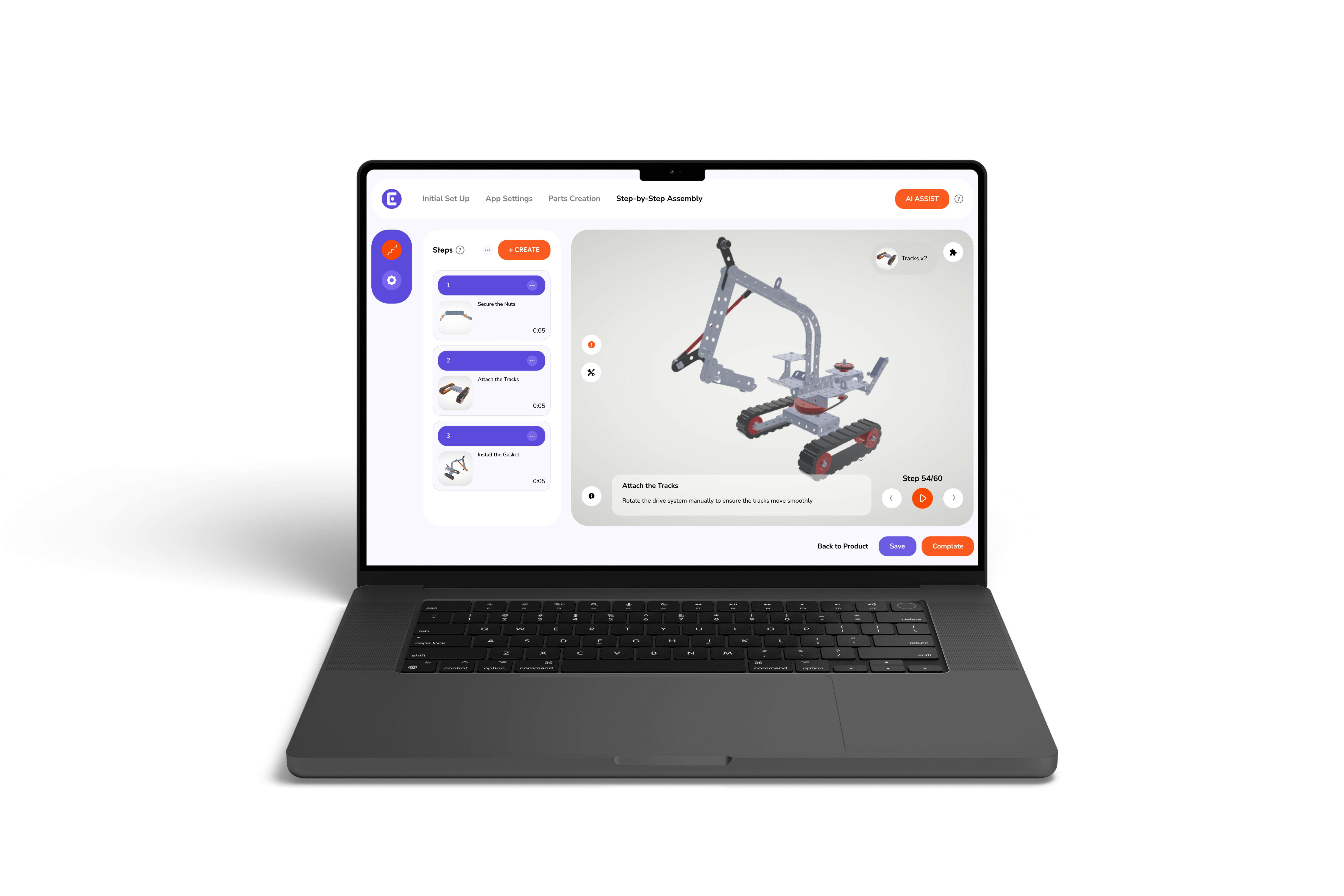
Instead of asking someone to imagine how a part fits, 3D product instructions show it, from every angle, in motion, in sequence. The user sees exactly where each component goes, how it connects, and what the completed step looks like before moving forward.
That shift has measurable outcomes. Errors drop because there is less room for misinterpretation. Assembly time decreases because users spend less time re-reading and second-guessing. And the overall product experience improves, which matters more than most manufacturers initially expect.
Moreover, interactive 3D instructions accommodate how different people actually learn. Some users are visual. Others need to see motion. Some work best when they can control the pace and angle of the information. 3D interactive formats support all of these approaches in ways that flat diagrams simply cannot.
The operational benefits of 3D interactive product manual go far beyond user experience. They directly impact efficiency, cost, and consistency across the entire business.
Digital assembly manuals can be updated instantly. When a product changes, the instructions update across all devices without reprinting or redistribution.
This removes version control issues completely and ensures everyone works with the latest information.
Outdated instructions create avoidable mistakes. When customers follow an old guide for an updated product, errors happen that are not their fault—but still damage the brand's experience.
In most cases, customers blame the product, not the instructions.
When instructions are unclear, customers contact support. Each interaction adds operational cost.
Improving clarity directly reduces support volume and cost.
3D visual instructions reduce the need for heavy translation because visuals communicate across languages.
Not every product has the same needs. However, certain categories consistently see the clearest return when they move to modern assembly instructions:
Understanding why tech products need better installation instructions often starts here — recognizing that the post-purchase experience is a product experience, and it deserves the same investment as the product itself.
The technology required to create interactive 3D instructions is no longer limited to large manufacturers with dedicated technical teams. Purpose-built platforms have made it accessible for brands of all sizes, without requiring CAD expertise or complex software pipelines.
At the same time, consumer expectations have shifted. A confusing manual is no longer quietly accepted. It becomes a one-star review. It becomes a return. Brands that recognize this understand that digital work instructions are not a future investment; they are a present-day operational need.
The combination of accessible technology and rising expectations is why the move from 2D to 3D assembly instructions is accelerating across industries. The question is no longer whether it makes sense. It is whether acting on it now puts you ahead or waiting puts you behind.
The shift from traditional manuals to modern digital guidance isn’t just about changing format; it’s about changing how information is experienced. Easemble is built around this exact transition, helping brands move away from static documentation and toward interactive, spatial instruction systems that are easier to understand, update, and maintain.
Through guided 3D assembly instructions, users can follow each step with clarity instead of interpreting flat diagrams. If you’re ready to understand how to make the move to paperless work instructions and transition to interactive 3D instructions, Easemble provides a practical way to make that shift seamless.
In conclusion, the shift from static manuals to interactive guidance reflects a bigger change in how people interact with products. Traditional methods often fall short when it comes to clarity, while modern approaches make complex assembly feel more intuitive and guided. The difference between 2D and 3D assembly instructions is no longer just visual; it directly impacts accuracy, speed, and user confidence. As more brands move toward digital-first experiences, clearer, more interactive instructions are becoming less of an upgrade and more of a standard.
3D instructions show parts from every angle, in motion, and in sequence. The result is fewer errors, faster assembly, and a better overall product experience.
Yes. Unlike printed manuals or static PDFs, digital 3D instructions can be updated in real time across all devices.
Products with multiple components, complex assembly sequences, or a global customer base benefit most, particularly furniture, electronics, fitness equipment, baby gear, and any product category where assembly errors consistently drive returns or support requests.