December 19, 2025
Benefits of 3D Interactive Product Manual - An Overview

.png)

Product manuals play a critical role in how users assemble, operate, and maintain products. However, traditional paper-based and PDF manuals often fail to deliver clarity, especially for complex products. As a result, businesses are increasingly shifting toward 3D interactive product manuals and digital product manuals to simplify instructions and enhance user experience.
In this blog, we explore the benefits of 3D interactive product manuals and why they are becoming a preferred choice across industries.
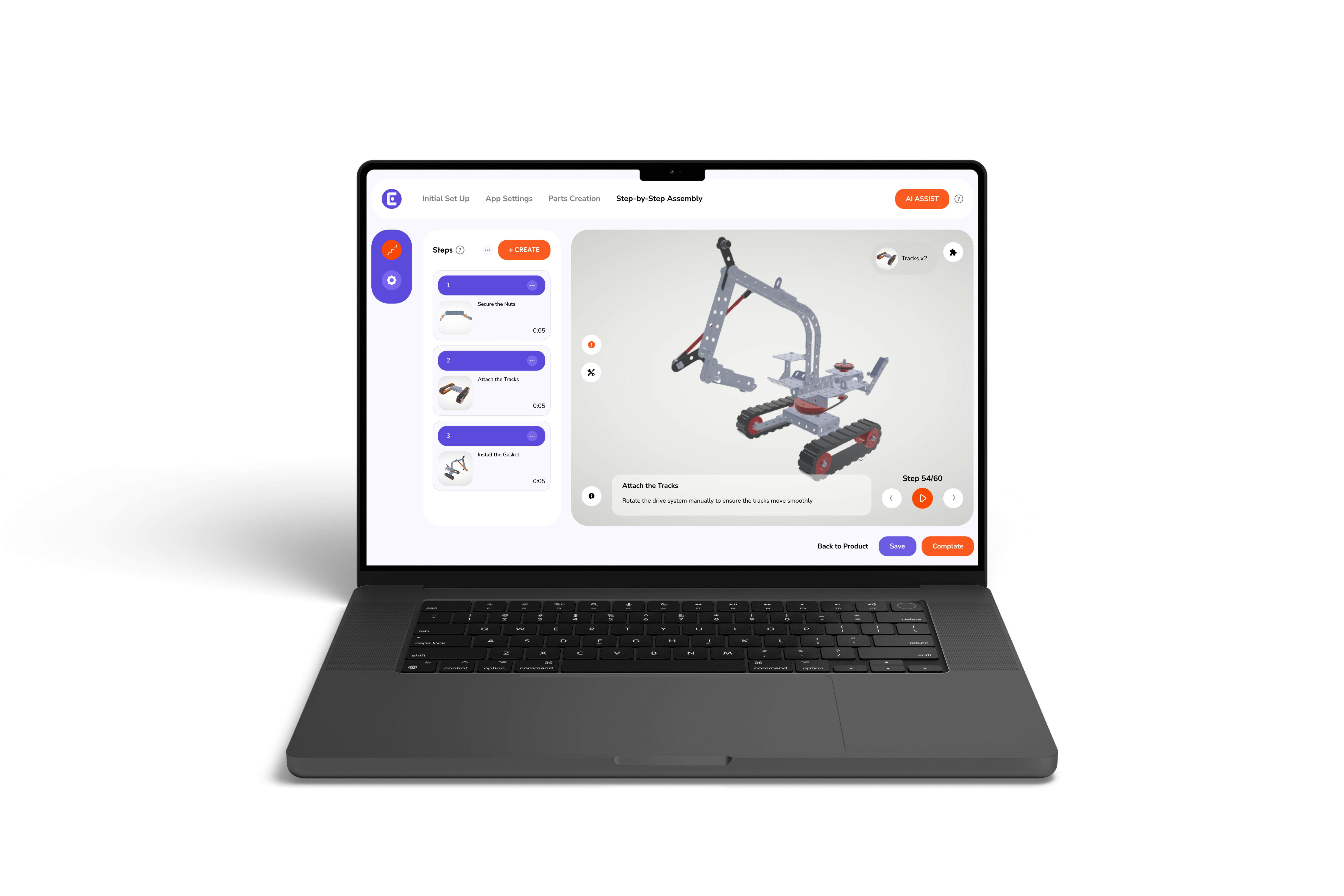
A 3D interactive product manual is a digital instruction format that uses interactive 3D models, animations, and guided steps to explain product assembly and usage.
Unlike static manuals, users can rotate models, zoom into components, and follow clear visual steps. These manuals are commonly delivered through web platforms, mobile devices, or integrated AR instruction guides.
Before understanding the benefits of 3D interactive manuals, it is important to recognize the limitations of conventional paper-based and PDF manuals.
Flat diagrams often fail to convey depth, perspective, or part orientation, making it difficult for users to fully understand how components fit together.
Instructions that involve multiple parts or precise sequences can be confusing, especially for first-time users or non-technical customers.
Users frequently rely on help desks, call centers, or service teams to clarify unclear steps, which increases operational costs.
Any modification to the product or instructions requires reprinting and redistributing manuals, adding time and expense.
Traditional manuals do not actively engage users, resulting in poor retention of information and an increased likelihood of mistakes.
Overall, these challenges often lead to incorrect assembly, higher product return rates, and decreased customer satisfaction. Moreover, repeated frustration with unclear manuals can negatively impact brand perception and loyalty, highlighting the urgent need for more interactive and user-friendly instruction solutions.
3D interactive manuals address these issues by providing real-time visual guidance and intuitive navigation.
Users can clearly see how parts fit together, follow step-by-step workflows, and avoid common errors. This approach transforms instructions from passive reading into active interaction.
Related insight: Why 3D Instructions Outperform PDF Manuals?
3D interactive manuals make assembly easier, faster, and error-free while improving overall user experience. We have listed the benefits of 3D interactive product manuals, down below:
Interactive 3D visuals show each step clearly so users can assemble with confidence.
Interactive 3D visuals remove ambiguity and significantly improve task accuracy. Users no longer rely on the interpretation of flat diagrams.
When instructions are clear, users complete tasks independently. This reduces support for tickets, service calls, and on-site visits.
Businesses using Interactive Instruction Manuals often report measurable support for cost reductions.
3D manuals accelerate learning for technicians, operators, and end users. Visual step-based guidance shortens training cycles and improves knowledge retention.
Digital product manuals can be updated instantly without printing or redistribution costs. This ensures users always access the most accurate instructions.
Learn more in How to Make the Move to Paperless Work Instructions?
3D interactive manuals are accessible on desktops, tablets, and mobile devices, enabling consistent instruction delivery across locations.
Platforms built as a Digital Assembly Solutions Provider support this scalability.
Clear visual instructions help users follow correct procedures and safety protocols, reducing risks and compliance issues.
Digital manuals provide analytics on usage behavior, helping teams improve both product design and instruction quality.
Many 3D manuals integrate with AR instruction guides, allowing users to view instructions directly on the physical product.
This enhances real-world usability and reduces cognitive load.
Although implementation requires planning, digital manuals deliver long-term savings through reduced printing, training, and support costs.
This transition is well explained in From Paper to Pixels
Compared to traditional formats, 3D manuals deliver better clarity, engagement, and completion rates.
For comparison, refer to 3D vs. 2D Assembly Instruction Manuals
To successfully adopt 3D interactive product manuals, organizations should ensure:
Meeting these prerequisites ensures a smooth transition from traditional manuals to interactive instructions, while supporting long-term scalability, accuracy, and ease of maintenance.
Businesses should consider transitioning when traditional manuals no longer meet user needs or operational demands. These indicators signal growing complexity and inefficiencies, and making the shift at this stage helps improve clarity, efficiency, and overall user satisfaction before issues escalate.
By transitioning at the right time, businesses can simplify instructions, reduce operational friction, and deliver clearer guidance that scales with product complexity and user expectations.
3D interactive product manuals are no longer optional for modern businesses. They improve accuracy, reduce support costs, and deliver superior user experience compared to traditional manuals. As organizations move toward digital-first instruction strategies, adopting interactive manuals becomes a strategic advantage rather than a technical upgrade.
Easemble offers tools that simplify the creation and delivery of interactive assembly and product manuals. For teams looking to implement scalable and user-friendly 3D instruction solutions, this is a great option. As a result, helping businesses provide hassle-free guidance at the fingertips of their users.
Products with multiple components, precise assembly steps, or frequent updates benefit the most, including industrial equipment, consumer electronics, furniture, and machinery.
No. Most 3D interactive product manuals are web-based and accessible through standard browsers on desktops, tablets, and mobile devices.
By providing clear visual guidance and step-by-step workflows, users can complete tasks independently, which reduces support tickets, service calls, and training time.
Yes. Digital product manuals allow instant updates and version control, ensuring users always access the latest and most accurate instructions without reprinting.