April 29, 2026
Quality Technical Documentation for Assembly and Service Manuals

.png)

When a manual is hard to follow, the product starts to feel harder to trust. That is a small issue on paper, but on the floor, it can slow work, create repeat questions, and raise stress for everyone involved.
Quality technical documentation solves that by giving people clear steps, plain language, and the right detail at the right moment. It helps assembly teams, service teams, and buyers do the job without guessing.
In this guide, we will look at what makes quality technical documentation strong, why assembly and service manuals need different treatment, what technical documentation best practices are, where weak content causes trouble, and how teams can improve with a simple process.
We will also touch on the future of 3D assembly instructions as documentation keeps shifting into more visual formats.
Quality technical documentation is clear, accurate, task-focused information that explains how to assemble, use, or service a technical product. It combines precise instructions, relevant visuals, logical structure, and consistent terminology to guide correct action.
A manual works best when words, steps, and visuals support each other. Clear language, logical order, and relevant images are essential for technical product instructions, where users need fast answers. Quality technical documentation should speak to real users, and a user-friendly assembly manual should feel clear from the first page.
When those parts line up, the manual starts doing real work. It lowers confusion, keeps people moving, and cuts down the back-and-forth that slows teams down.
Assembly and service manuals serve different purposes. Assembly guides explain how to build a product in the correct order, while service guides show how to inspect, repair, or replace parts safely after use.
Assembly and service instruction manuals require a unique detail and flow. Assembly guides focus on sequence, fit, and warnings. Service guides focus on access, diagnostics, and safe replacement. Quality technical documentation keeps these roles clearly separated.
Furthermore, service instruction documentation must be precise and easy to trust, especially under time pressure. If it lacks clarity, repairs slow down, and support requests increase.
Weak manuals do not always fail in dramatic ways. More often, they fail in small, annoying ways that keep showing up again and again. A step gets skipped. A part gets mixed up. A worker has to stop and check with a supervisor. Then the same issue happens again on the next unit.
The first signs are usually simple. A screw is placed in the wrong hole. A panel faces the wrong way. A warning is missed because it is buried under too much text. That is where product documentation quality becomes easy to spot, because the same mistake keeps coming back.
A manual should reduce doubt. If users keep asking the same questions, quality technical documentation is lacking, and delays or rework often follow.
That gap matters because every small mistake costs time. And once the work stops, momentum is hard to get back.
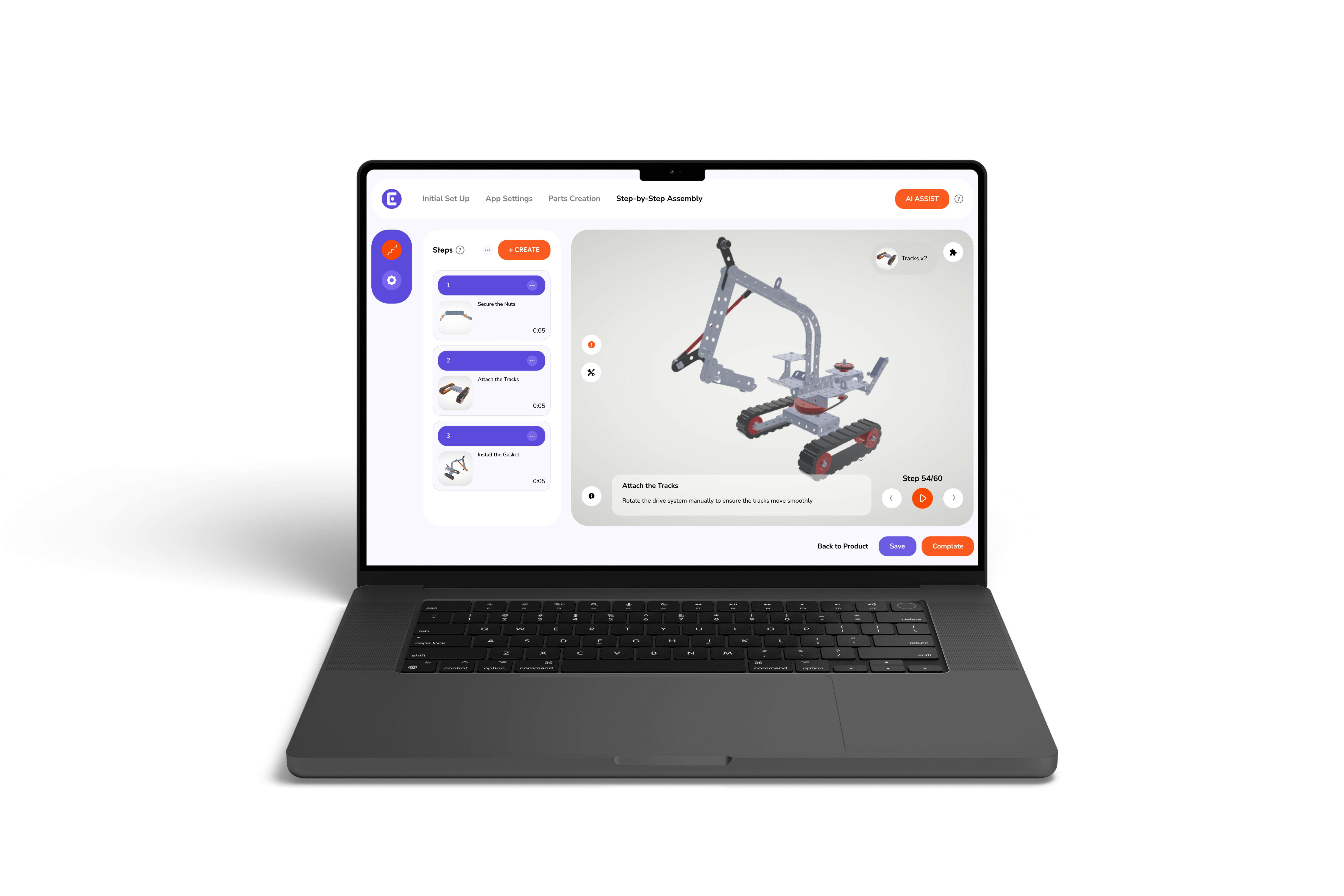
Good technical documentation does more than list steps. It helps different users see the product clearly and handle it with less confusion. That is where 3D digital manuals add real value. They make quality technical documentation easier to understand, easier to follow, and easier to trust.
When the manual is visual and interactive, the content becomes easier to check, update, and use in real work. That is how quality technical documentation becomes more consistent across teams.
Better manuals do not usually come from one big rewrite. They come from a steady process. Teams that review one product, one task, or one pain point at a time usually get better results because they can clearly see what changed and why it matters.
Start with the user, not the writer. Focus on what they already know, what they need, and where they might get stuck. For tech products instructions, steps should match the real setup, not an ideal version.
Read it like a first-time user. Check order, labels, part names, and images. For service work, ensure the path is clear, and technical documentation for assembly instructions does not force the reader to search for the next step. That is where quality technical documentation becomes a consistent practice.
Moreover, visual guidance can simplify complex steps, and the future of digital assembly instructions is moving in that direction. In many cases, interactive work instructions will sit between paper-based habits and clearer digital flows.
The value of quality technical documentation goes beyond a single manual. It directly affects how quickly people learn a product, how confidently they handle repairs, and how smoothly field work runs. When instructions are clear and visual, teams do not waste time double-checking steps or waiting for clarification.
Training becomes easier because new users can follow guided steps without confusion, especially when supported by digital assembly instructions or 3D visuals. Field teams can keep working by quickly referencing interactive guides on mobile devices instead of stopping for help. Service work also becomes more reliable when repair paths are clearly mapped in service instruction documentation, reducing trial and error during fixes.
In short, quality technical documentation turns into a practical tool rather than a reference file. It supports real work on the floor, not just theory on paper.
Easemble helps teams build clear assembly and service documentation without adding process complexity. It makes it easier to create structured content, manage updates, and keep product information accurate as things change. For teams relying on quality technical documentation, this reduces friction in day-to-day work.
It also improves consistency across teams. When documentation is easy to maintain, the people using it on the floor notice the difference quickly. This becomes especially important when one team creates the manual, and another depends on it during real assembly or service work.
Quality technical documentation makes products easier to assemble, service, and support, but only when it is usable in real work conditions. Static manuals often fall short as complexity grows on the floor. 3D digital and interactive manuals help close that gap by adding visual clarity, structured steps, and real-time usability for teams in assembly and service.
If you want manuals that actually work in real environments, the next step is moving from static documents to interactive, structured digital guidance built for daily use.
It uses plain language, clear steps, and visuals that match the task. A reader should not have to guess what comes next.
Yes. Assembly content and service content solve different problems, so they should be written with different goals in mind.
They should be reviewed whenever the product changes, and also on a regular schedule to catch small gaps before they grow.
Yes, but the content still needs to stay separated by task so the reader can find the right path fast.