June 18, 2026
Your Customers Are Using Their Phones to Read Manuals. Are Your Product Instructions Ready for the Mobile Era?
.png)

A customer receives their new product. The packaging feels premium, the design looks impressive, and the unboxing experience creates excitement.
Then comes the first real test.
They scan the QR code to view the instructions on their phone and expect an easy and intuitive experience. Instead, they open a static PDF filled with tiny text, unclear diagrams, and endless scrolling. What should have been a simple setup process quickly becomes frustrating.
As customers rely more on digital and mobile experiences, they expect product instructions to be just as intuitive as the apps they use every day.
Documentation is no longer just a support asset; it is a key part of the customer experience after purchase. When instructions fail, businesses may see more support requests, avoidable returns, and reduced customer trust.
Quick Answer
Why Are Traditional Manuals Failing Modern Customers?
Traditional manuals often fail because they were designed for printed pages rather than mobile screens. Static PDFs can be difficult to read, navigate, and understand on smartphones.
Modern brands are increasingly adopting digital product instructions and 3D interactive assembly manuals that provide mobile-friendly, visual guidance and help customers complete tasks with confidence.
Customers expect seamless digital experiences throughout every stage of their journey. Yet many brands continue to provide documentation that was originally designed for paper.
This gap between customer expectations and outdated documentation creates what we call the mobile experience gap.
The mobile experience gap is the difference between the digital experiences customers expect and the outdated documentation experiences many brands still provide.
Companies invest heavily in product design, packaging, marketing, and customer acquisition. However, when customers finally need instructions, they are often handed a PDF that feels disconnected from the rest of the brand experience.
Common issues include:
Mobile devices account for approx. 64 percent of global web traffic. For many customers, a smartphone is the primary device used to access product information, support resources, and assembly instructions.
If your documentation is not optimized for mobile use, it may already be creating friction for a significant portion of your audience.
Open your current digital instructions on a smartphone and ask:
If the answer is no, your documentation may be working against your customer experience goals.
Customer behavior has changed.
People are accustomed to interactive applications, visual interfaces, touch-based navigation, and instant access to information. They do not expect to spend time decoding complicated instructions.
They simply want to complete a task successfully. Whether assembling furniture, installing equipment, or setting up a consumer product, customers expect guidance that feels intuitive and easy to follow.
Mobile internet usage continues to exceed desktop usage globally. This shift means documentation must be designed for smaller screens and touch-based interactions rather than adapted from print formats.
Brands that embrace mobile-friendly manuals can create smoother onboarding experiences, reduce customer frustration, and improve product adoption.
Many brands focus heavily on getting customers to buy their products.
Far fewer focus on what happens after the purchase.
Yet the assembly and setup process is often one of the most memorable moments in the customer journey. It is the point where customers begin forming opinions about how easy, intuitive, and valuable the product actually is.
A premium product paired with frustrating instructions creates a disconnect.
A premium product paired with clear, interactive guidance reinforces confidence and satisfaction.
Documentation is no longer simply a technical requirement. It is a customer experience asset.
Poor documentation rarely appears on a profit-and-loss statement, but its impact can be felt across multiple areas of a business.
When customers cannot understand instructions, they seek help elsewhere.
That often results in:
Every unnecessary interaction increases operational overhead and places additional strain on support teams.
Well-designed manufacturing documentation acts as a self-service support channel, which helps customers find answers independently.
Many products are returned not because they are defective, but because customers struggled to assemble or use them correctly.
Common causes include:
Improving documentation can help reduce product returns by eliminating avoidable confusion.
The final stage of the customer journey often shapes the lasting impression.
If assembly feels frustrating, customers frequently associate that frustration with the product itself.
Expert Insight
Customers rarely separate the quality of a product from the experience of using it. A confusing setup process can make even a well-designed product feel unnecessarily difficult.
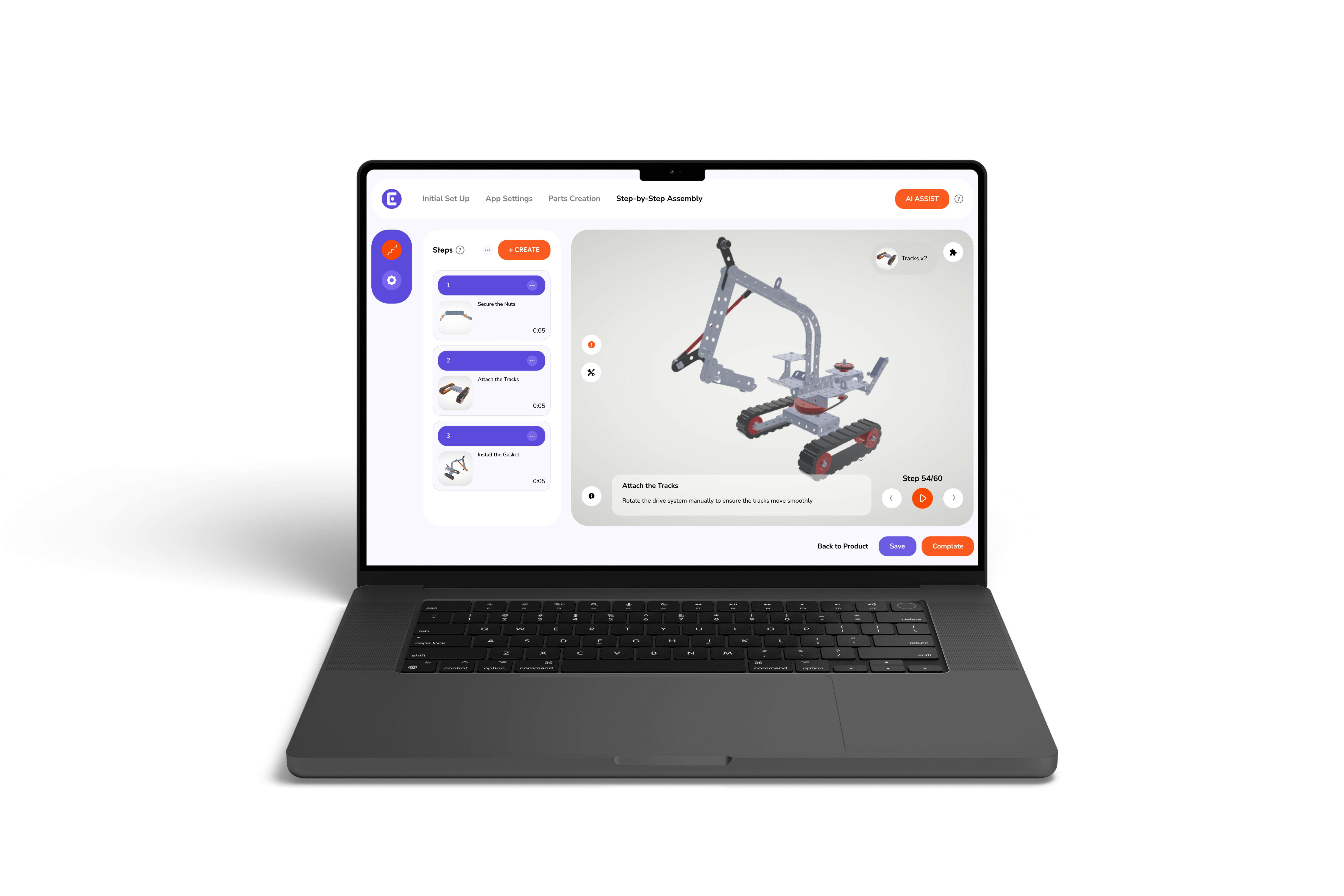
A 3D interactive assembly manual uses three-dimensional models, animations, and interactive guidance to help customers understand assembly steps digitally.
Unlike traditional PDFs, users can:
Instead of interpreting flat diagrams, customers can see exactly how components fit together.
This significantly improves clarity and reduces errors during assembly.
As customer expectations shift toward faster, more visual, and mobile-first experiences, brands are moving beyond static PDFs and adopting interactive documentation that makes products easier to understand and use.
Modern customers already understand how to swipe, pinch, zoom, and rotate content on touchscreens.
Interactive manuals build on these familiar behaviors, creating a more natural learning experience.
Benefits include:
Traditional manuals often overwhelm users with dense text and complex diagrams. Interactive instructions focus attention on exactly what matters in each step.
This follows a simple principle: Show, don't explain.
When customers can see the action they need to perform, understanding becomes faster and easier.
Customers may access instructions from a premium tablet, an entry-level smartphone, or a desktop computer.
Modern interactive product manuals are designed to perform consistently across devices, which ensured every customer receives the same quality experience.
The difference goes beyond usability. Interactive documentation helps customers complete tasks more confidently while reducing operational burden for businesses.
For growing manufacturers and e-commerce brands, documentation management becomes increasingly complex.
Every product update, language variation, and regional requirement adds additional work.
Digital assembly instructions simplify this process through:
One of the biggest advantages is that visual instructions often communicate more effectively than text alone.
A customer can understand how a screw fits into a housing regardless of language. This makes 3D product instructions a powerful tool for serving global audiences.
The future of documentation extends beyond static content.
Emerging technologies are creating opportunities for:
Customers increasingly expect guidance that adapts to their needs rather than forcing them to navigate complex manuals.
Brands that modernize documentation today will be better positioned for these future expectations.
Easemble helps manufacturers and product companies transform documentation into interactive, mobile-friendly experiences.
By combining digital product instructions, 3D visualization, and scalable documentation management, Easemble enables brands to deliver clearer guidance while reducing operational complexity.
The goal is simple: help customers succeed faster while creating a better post-purchase experience.
A product experience does not end when a customer opens the box. The instructions they follow, the ease of setup, and the support they receive all shape how they perceive the brand. As customers continue to rely on smartphones for information, traditional PDFs are no longer enough to deliver the seamless experiences they expect.
By adopting digital product instructions and 3D interactive assembly manuals, brands can create clearer guidance, reduce customer frustration, improve post-purchase experiences, and build stronger connections with their users. The future of product documentation is not just about sharing information; it is about making every interaction simpler, smarter, and more valuable.
PDF manuals are often designed for printed pages rather than smartphones. On smaller screens, users may need to zoom, scroll, and search constantly, making product setup slower and more frustrating.
3D interactive assembly manuals are digital instructions that use 3D models, animations, and visual guidance to help users understand how products are assembled. Customers can rotate, zoom, and view parts from different angles for easier setup.
Yes. Clear digital product instructions help customers solve setup problems independently, which can reduce unnecessary support tickets and improve the overall customer experience after purchase.
Mobile-friendly manuals help customers access and understand product instructions easily on smartphones and tablets. They help customers complete tasks faster by providing clear visuals, simple navigation, and step-by-step guidance.
Interactive product manuals offer a more engaging experience than traditional instructions because they provide visual explanations, easier updates, and a more flexible way for customers to understand complex products.