May 23, 2026
Poor Assembly Instructions Are Costing You Money: The Hidden Costs Your P&L Doesn’t Show

.png)

Every manufacturer tracks materials costs, labor overhead, and shipping margins. But there is typically one significant expense that never appears on a P&L statement, and it is often one of the most damaging.
It is called the Assembly Tax: the compounding financial cost of every returned product, every support call, every free replacement part, and every lost future sale that traces back to one root cause, a confusing user manual.
This is not a design problem. It is a revenue problem. And in 2026, as customers increasingly make purchasing decisions based on post-unboxing experience, the brands that have eliminated the assembly tax are quietly outperforming those that have not. This article breaks down exactly where the cost lives, what it is worth to your bottom line, and how leading manufacturers are solving it.
The Assembly Tax is not a single line item. It is the aggregate financial damage caused by inadequate assembly documentation, spread across returns, support operations, parts logistics, and brand equity.
Your accounting software will not label it as such. But your customer reviews will.
When a customer cannot successfully assemble your product, the failure typically triggers a cascade: they call support, they force parts together (breaking them), they return the product, and they leave a public review.
Each of these actions has a measurable cost. The challenge is that most manufacturers attribute these costs to separate departments, making the root cause invisible.
Paper-based manuals, and their PDF equivalents, were designed for a linear reading experience. They rely on static 2D diagrams, ambiguous directional language, and an assumption that every user shares the same spatial intuition.
In practice, that assumption fails regularly, especially in categories like electronics assembly manuals, where circuit board orientation matters, and construction assembly manuals, where structural errors have real safety implications. A single misread diagram in either category is enough to generate a support ticket, a return, or worse.
Understanding the assembly tax requires mapping each of its component costs. In most cases, these are distributed across departments and never aggregated, which is precisely why the problem persists.
Industry data consistently suggests that a significant share of products returned as "defective" are functionally intact. The customer simply could not complete the assembly. When your returns team processes these, they are often logged under product quality, masking the true driver.
Each of these returns carries not just the direct cost of reverse logistics and restocking, but the hidden cost of a failed customer relationship.
A single support call to walk a customer through an assembly step typically costs between $8 and $25 in fully loaded operational expenses. Multiply across tens of thousands of units shipped, particularly during peak season, and the overhead becomes material.
Vague instruction language ("align tabs as shown") is often the trigger. The customer is not confused about the product; they are confused about the documentation.
Frustrated customers do not stop asking for help. They often push through, literally. Forcing misaligned parts together is among the most common causes of component breakage that ends with a free replacement request.
These costs are typically absorbed by your customer service budget, disconnected entirely from documentation quality.
This is the most expensive line item that never appears on any report. A parent who spent three hours confused by a toy assembly manual on a Saturday afternoon will not buy from that brand again. And in most cases, they will say it so publicly.
A single one-star review citing assembly difficulty can measurably reduce conversion rates for months on platforms where reviews are weighted algorithmically.
The table above reflects general patterns observed across manufacturing verticals. Individual results will vary based on product complexity, category and implementation of quality.
The shift from static documentation to interactive digital assembly solutions is not primarily a design upgrade; it is a financial decision.
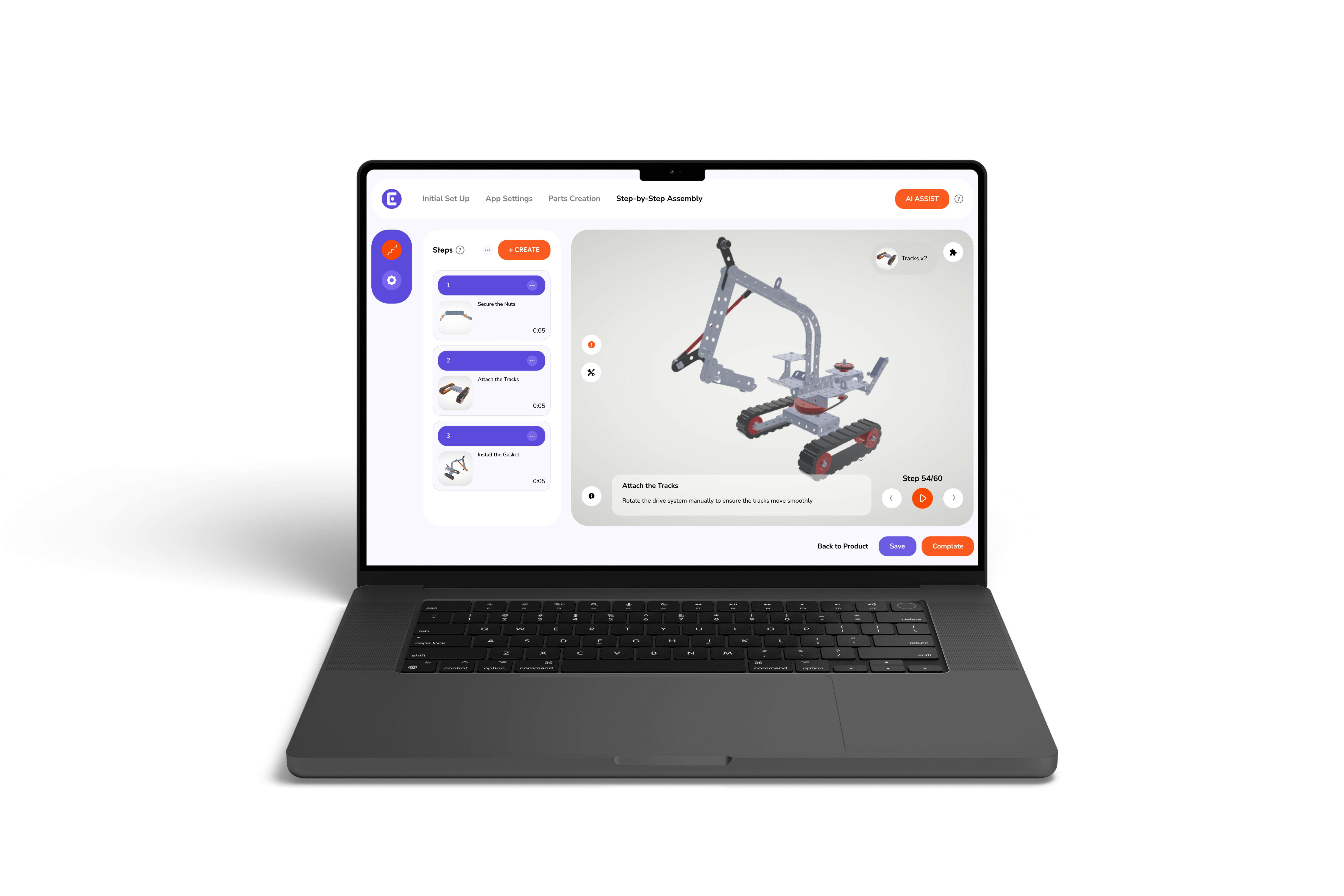
When a customer opens a 3D instruction experience, they are no longer interpreting a flat drawing. They can rotate a component, watch an animation of how two parts engage, and progress step-by-step with visual confirmation. The cognitive load drops substantially, and with it, the error rate.
Brands that have effectively eliminated the assembly tax share a few common practices. They treat documentation as a product, not a deliverable. They allocate budget to post-purchase experience with the same discipline they apply to pre-purchase marketing. And they measure downstream effects, return rates, support volume, and review sentiment as direct indicators of documentation performance.
This is not a radical operational shift. It is a reframe: the user manual is not the final step of product development. It is the first step in customer relationships.
In verticals where purchases are seasonal and reputational, such as toys, outdoor equipment, modular furniture, and consumer electronics, the brands earning five-star reviews for setup experience are typically the same brands seeing the highest repurchase rates. That is not a coincidence.
The Assembly Tax is real, measurable, and, in most organizations, entirely avoidable.
By moving from static paper guides to interactive digital assembly solutions, manufacturers can typically reduce avoidable returns, lower support overhead, and transform a historically passive document into an active driver of customer loyalty. The investment pays back through reduced operational friction, and it shows up in your reviews before it shows up in your financials.
If your brand is still relying on a static manual to carry the post-purchase experience, the question is not whether you are paying the assembly tax. It is how much.
Easemble helps manufacturers calculate and eliminate that cost, with interactive 3D assembly documentation built for modern products, modern customers, and modern margins.
Assembly Tax is the hidden cost manufacturers incur when customers fail to properly assemble or use a product. It leads to returns, support calls, replacements, and lost future sales caused by unclear instructions rather than product defects.
Because it is not recorded as a single expense. Instead, it is distributed across returns, customer support, logistics, and marketing, making it invisible in standard P&L reporting even though it significantly impacts profit margins.
The cost varies by industry and scale, but even small increases in return rates or support tickets can result in thousands to millions in annual losses due to compounding effects across operations, logistics, and customer retention.
A significant share of returns in categories like furniture, electronics, and toys are caused not by product defects but by assembly confusion, unclear instructions, or user misinterpretation of setup steps.
Clear or interactive instructions reduce user errors, which directly lowers return rates, support ticket volume, product damage, and negative reviews, improving both operational efficiency and overall revenue performance.