April 4, 2025
3D vs. 2D Assembly Instruction Manuals: Key Differences & Best Use Cases

.png)

Having customers return products because they struggled with assembly?
Tired of wasting time and money revising traditional paper-based manuals, only to face the same complaints?
The issue isn't necessarily how your manual is written — it's the limits of traditional 2D manuals.
Flat diagrams and static images can only do so much to guide customers through complex assemblies. They're often hard to follow, making it difficult to visualize steps clearly.
That’s where 3D interactive manuals come in.
Instead of static, confusing diagrams, 3D manuals allow customers to rotate, zoom, and explore every component from any angle — making assembly faster, easier, and far more intuitive.
The results?
✔️ Fewer mistakes
✔️ Fewer returns
✔️ Better customer experiences
✔️ Higher review scores
✔️ Fewer support tickets
If that sounds like something your business could use — you’re in the right place.
In this post, we’ll cover:
Let’s dive in!
Most of us are already familiar with 2D assembly manuals. They’re the standard PDF or paper instructions included with ready-to-assemble (RTA) and do-it-yourself (DIY) products — from furniture and toys to gym equipment and beyond.
And while they’re everywhere, 2D manuals have serious limitations:
Take, for example, a typical 2D manual for a bicycle assembly - Without the ability to rotate or explore the components interactively, even a simple step can turn into a major obstacle.

Pretty confusing, right?
To make sense of that 2D manual, you’d have to carefully study each illustration, compare it to the actual bike parts in front of you, and cross your fingers you're doing it right.
That’s exactly where 3D interactive manuals shine.
Instead of relying on flat, static images, 3D manuals use accurate models and animations to guide users through each step visually.
You’re no longer left guessing what a diagram means — you can rotate, zoom, and isolate components to understand how everything fits together.
Take a look at this example of a 3D bicycle assembly manual and compare it to the traditional 2D version above — the difference is night and day.
See the difference?
That’s 2D vs. 3D manuals in a nutshell:
📄 2D = guesswork and frustration.
🌀 3D = clarity, interaction, and ease.
But enhanced visualization isn’t the only factor to consider. Both 2D and 3D manuals have their strengths — and knowing when to use each can help you deliver the best experience to your customers.
Let’s break down the pros and cons of each approach.
3D assembly manuals don’t just make life easier for your customers — they deliver real, measurable value for your business. Here’s how:
While 3D manuals may require a higher upfront investment, they quickly make up for it by:
3D manuals help customers set realistic expectations before purchasing and guide them clearly during assembly — minimizing frustration and mistakes that often lead to returns.
Many negative product reviews are the result of poor assembly experiences. With 3D manuals, customers are more likely to complete assembly successfully and leave a positive review.
When customers get stuck during assembly, they often turn to your support team. Easemble empowers them to solve issues on their own — saving time and reducing support volume.
Digital manuals reduce your environmental footprint — something today’s eco-conscious customers notice and appreciate. Plus, interactive instructions show your brand is modern and customer-focused.
Including a 3D manual preview on your product’s landing page allows customers to see how easy assembly will be. This builds confidence in the buying decision and positions your brand as innovative.
While 3D manuals are powerful, they’re not always necessary for every product. Here’s how to decide if it’s the right fit:
Want to start reaping the benefits? With Easemble™, creating your first 3D manual is simple. Here's how:
You’ll need a 3D model of your product in FBX or GLB format, under 50 MB. If you don’t have one, you can have it created in any 3D modeling software.
Create your Easemble account — it takes less than a minute.
Click “Create” in your dashboard, then:
Once everything’s in place, hit “Publish” and your interactive manual will instantly be available to customers on mobile, tablet, or desktop.
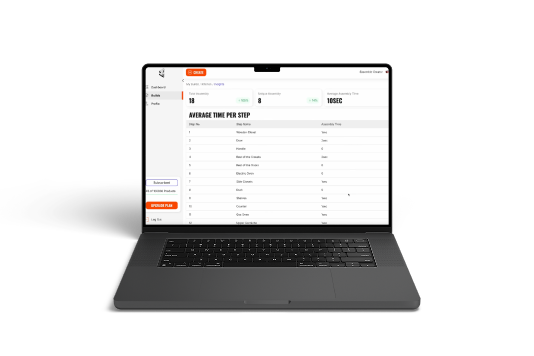
Use Easemble’s built-in analytics to track where customers drop off or struggle — and quickly update your manual to improve clarity.
While 2D manuals have long been the standard, 3D interactive manuals are redefining how customers experience product assembly. They reduce confusion, minimize support issues, and boost satisfaction — all while positioning your brand as modern, helpful, and forward-thinking.
Ready to experience it for yourself?
👉 Create your first 3D manual with Easemble™ today.
.png)