March 31, 2026
The $100B Problem: Why Digital Assembly Solutions Win
$100 billion lost every year. Not from bad products, but from poor instructions.
.png)

In modern manufacturing, companies optimize the first mile. Raw material sourcing is refined, Just-In-Time (JIT) systems are implemented, and production lines are optimized down to seconds. Significant investment goes into marketing to ensure the customer completes the purchase.
Yet a major gap remains in the last mile—the moment the customer opens the box.
Despite advances in technology, the bridge between a high-quality product and a successful user experience is often a simple paper manual. This is not a minor inconvenience. It is a structural weakness in the post-purchase experience, contributing to billions in unnecessary returns, support costs, and brand erosion.
Digital assembly solutions are not just a technological upgrade, they address a fundamental human challenge.
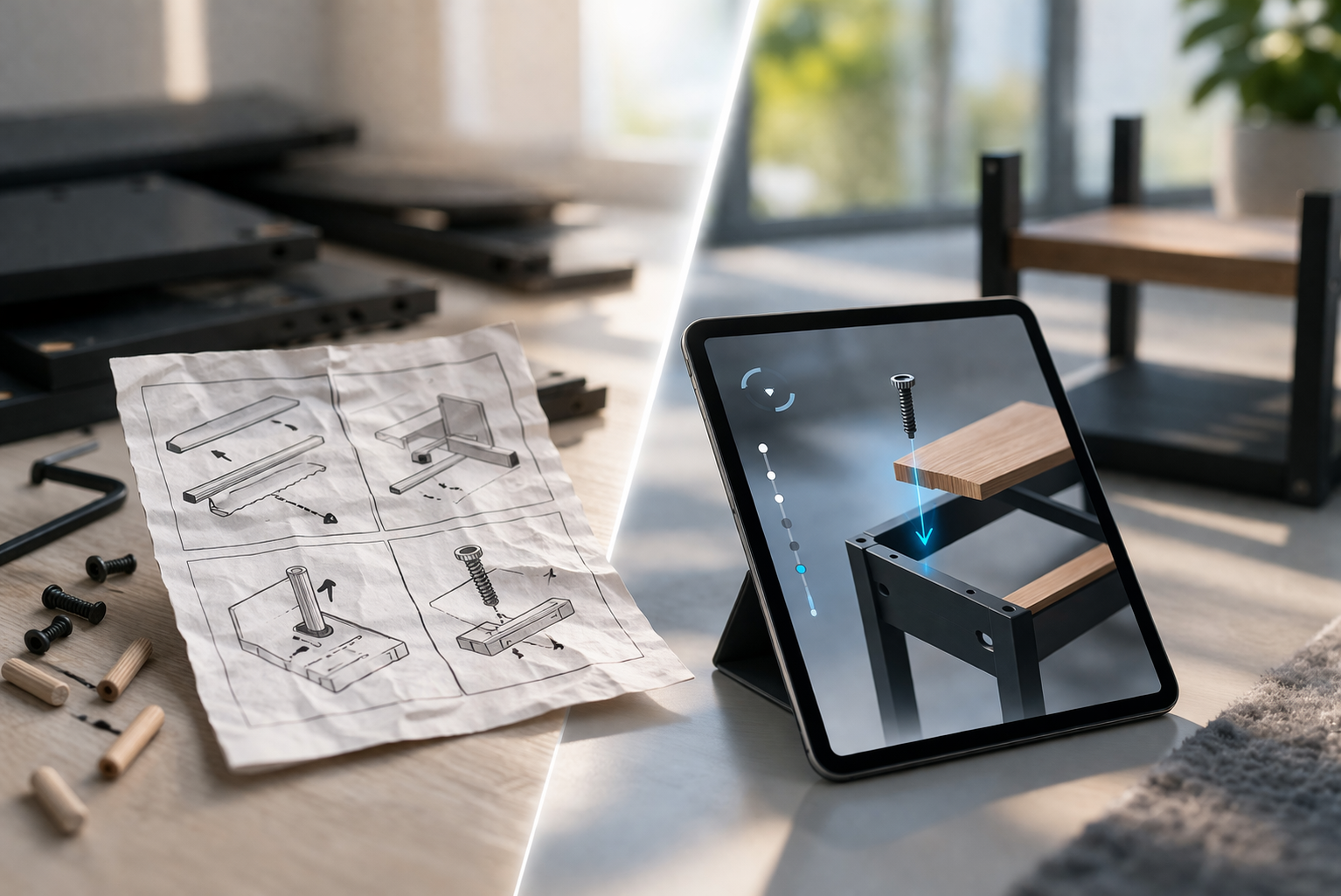
Users are visual and spatial learners. Traditional manuals require them to perform “mental rotation,” converting 2D diagrams into 3D understanding.
This creates instructional friction.
When diagrams are unclear, cognitive load increases. Frustration follows. This often leads to mistakes early in the process, reducing confidence and increasing the likelihood of abandonment.
In today’s market, friction is not tolerated. A customer who struggles with assembly is significantly more likely to return a product, even if it is fully functional.
From an operational perspective, the impact is measurable.
A significant portion of product returns fall under “No Fault Found” (NFF). These are products that are returned not because they are defective, but because users could not assemble or understand them.
Each return carries costs:
Digital assembly solutions reduce these risks by improving clarity:
Reducing friction in assembly directly protects margins.
The product experience does not end at purchase. It is defined during use.
While packaging and unboxing are important, the defining moment occurs when the product is successfully assembled and functional.
Clear, interactive instructions contribute to brand integrity. They demonstrate that quality extends beyond the product itself.
At the same time, improved instructions reduce pressure on support teams, allowing them to focus on complex issues rather than repetitive assembly questions.
Digital assembly introduces a critical advantage: visibility.
Unlike paper manuals, digital instructions provide data on user behavior:
This creates a feedback loop between users and product teams.
If a specific step consistently causes friction, it signals an opportunity to improve both the instructions and the product design. This enables a shift from reactive support to proactive optimization.
The transition to digital assembly is not only about usability. It also delivers operational and environmental benefits.
A digital-first approach provides both agility and sustainability.
The expectations of modern users have evolved. Interfaces are intuitive, information is immediate, and experiences are seamless.
Relying on static, paper-based instructions creates a disconnect between product quality and user experience.
Digital assembly solutions close that gap. They reduce friction, improve outcomes, and strengthen the relationship between manufacturers and users.
The product is only part of the value. The experience completes it.