May 20, 2026
How 3D Assembly Guides Help Brands Build Customer Trust Before Checkout
.png)

Most shoppers don't abandon a cart because of the price. They leave because they're not sure what they're getting into. Assembly uncertainty, that quiet, unspoken fear of opening a box and facing an impossible pile of parts, is one of the most underestimated conversion killers in e-commerce.
That's where 3D assembly guides change the game.
Ask yourself: when was the last time a product page answered the question "How hard is this to put together?"
In most cases, it didn't. Product pages show dimensions, materials, and lifestyle photography. However, they rarely show the assembly experience. That gap creates doubt, and doubt delays purchase decisions.
Research consistently shows that product uncertainty is a leading driver of cart abandonment. For furniture, flat-pack goods, electronics, and industrial equipment, the question of assembly difficulty sits at the heart of that hesitation.
Meanwhile, the cost compounds. Customers who do complete a purchase without clarity often experience expectation of mismatch, and that leads directly to returns. In fact, returns in ecommerce can reach 20–30% of total units shipped, with "not as expected" cited as a top reason. Beyond that, pre-sale support tickets pile up with the same question over and over: "Is this easy to put together?"
The real issue is that brands have historically treated assembly guidance as a post-purchase problem. It isn't. It's a pre-purchase trust problem.
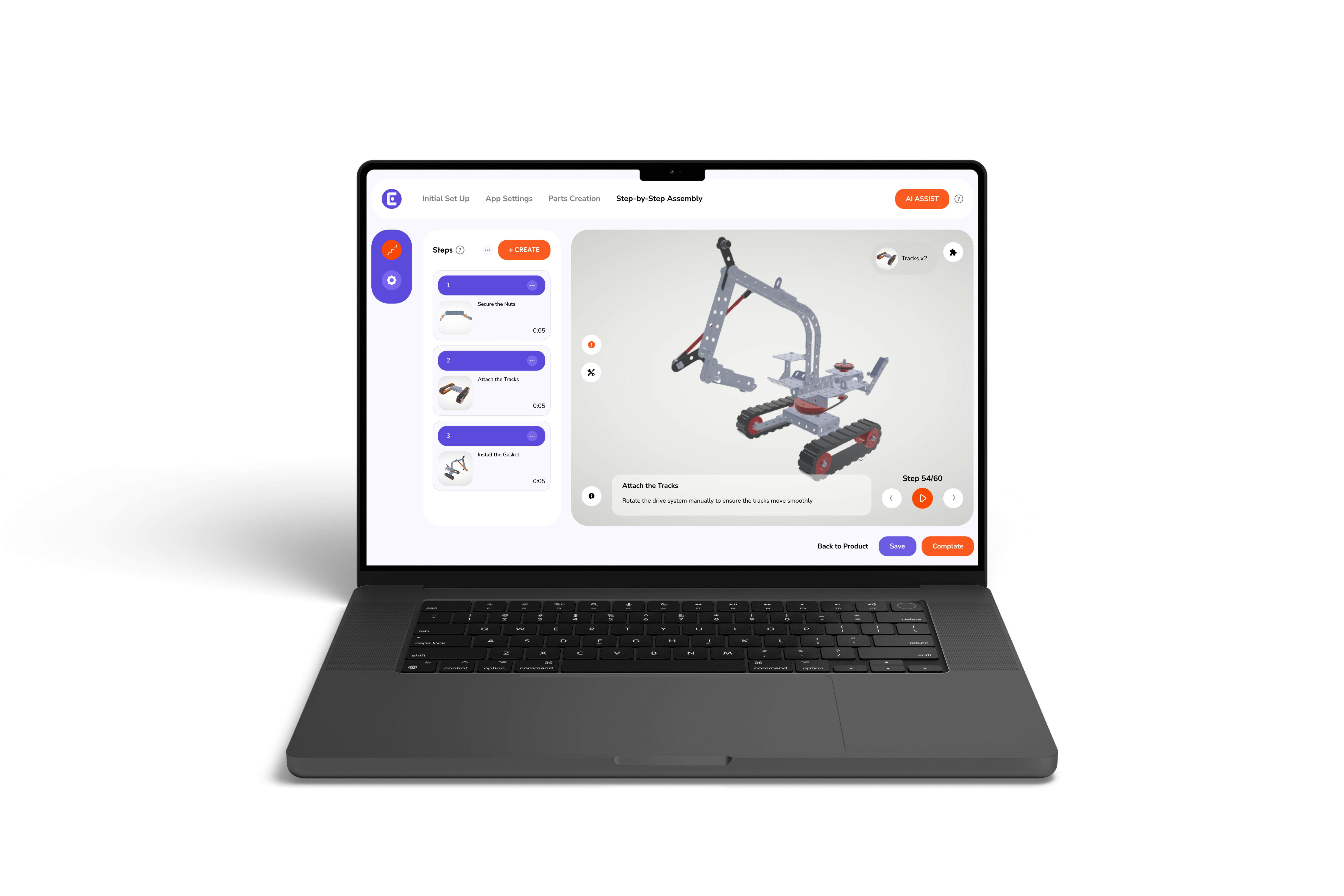
A 3D assembly guide is an interactive or animated visual tool that shows how a product is built, step by step, using three-dimensional rendering. Unlike a static instruction sheet or a flat diagram, it lets potential customers rotate, zoom, and step through the build process before they ever commit to buying.
That's worth sitting with for a moment. These aren't documentation tools; they're confidence tools.
When a shopper can see the assembly process ahead of time, several things happen in parallel.
In practice, transparency functions as a trust signal. Transparency and product confidence are closely linked in buyer psychology. When a brand shows the full assembly journey, it demonstrates confidence in the product's quality and usability.
As a result, the hesitation that typically kills conversions gets replaced by informed intent.
Static manuals have never been great at pre-sale work. Similarly, 2D diagrams require significant mental effort to decode. A shopper scanning a product page has roughly 8–15 seconds of sustained attention to work with. Text-heavy PDFs don't fit that window.
However, 3D visualization, communicates complexity instantly. A single animated exploded-view of a shelving unit tells a customer more in 10 seconds than three pages of numbered instructions. What's more, it answers the emotional question beneath the practical one: "Can I actually do this?"
That emotional reassurance is where conversion lift happens.
If your product involves any level of customer assembly, setup, or installation, here's a practical framework for integrating 3D assembly guides into your pre-purchase experience.
Easemble is built specifically for this workflow, which allows product teams to generate and publish 3D assembly guides without requiring a full 3D design team, which makes this strategy accessible for brands at various stages of scale.
Even brands that recognize the value of visual assembly guidance often stumble in execution. Here are the most frequent missteps.
Assembly content is typically created after launch, for customer support purposes. However, the conversion value comes from surfacing it before purchase. The sequencing matters.
Some brands fear that showing all the steps will discourage buyers. In practice, the opposite is often true. Hiding complexity doesn't remove it, it just moves the frustration to post-purchase, where it becomes a return.
A detailed 3D guide buried in a "Support" section does almost nothing for conversion. The same asset, placed on the product page, can meaningfully shift purchase behavior. The content isn't the bottleneck, placement and timing are.
A visually rich 3D experience that lags or breaks on mobile creates more distrust than no guide at all. Always test across devices before publishing.
The contrast here isn't about technology preference. It's about where in the customer journey the content does its work.
Creating a strong assembly experience shouldn't require a dedicated 3D team or a complex workflow. Easemble helps brands transform traditional instructions into interactive 3D assembly experiences that fit directly into the customer journey.
Instead of treating assembly guidance as something customers see after purchase, Easemble helps product teams bring it forward, right where buying decisions happen. Brands can create visual, step-by-step assembly experiences that reduce confusion, answer common setup questions, and help customers understand exactly what to expect before checkout.
Whether it's electronics, construction, or toy assembly manuals, Easemble makes it easier to scale assembly content across different product categories without increasing operational complexity.
More importantly, it's not only about creating better instructions. It is about creating innovative assembly solutions that reduce support requests, lower return rates, and build confidence at every stage of the customer journey.
Customers buy with more confidence when they understand what comes after the checkout button. 3D assembly guides reduce uncertainty, create clearer expectations, and help turn hesitation into action.
For brands, this means more than a better customer experience. It means fewer returns, lower support costs, and stronger trust. As buying decisions become increasingly experienced-driven, the brands that make products easier to understand will have a clear advantage.
They are interactive visual tools that show how a product is assembled step by step, helping customers understand setup before buying.
By reducing uncertainty. When shoppers clearly see the assembly process, they feel more confident and are less likely to abandon their purchase.
Yes. They align expectations before purchase, so customers are less likely to feel surprised or misled after delivery.
Because unclear setup creates uncertainty. Shoppers often avoid buying if they cannot estimate difficulty or time required.
Yes. They set clear expectations before checkout, reducing “not as expected” returns caused by assembly confusion.